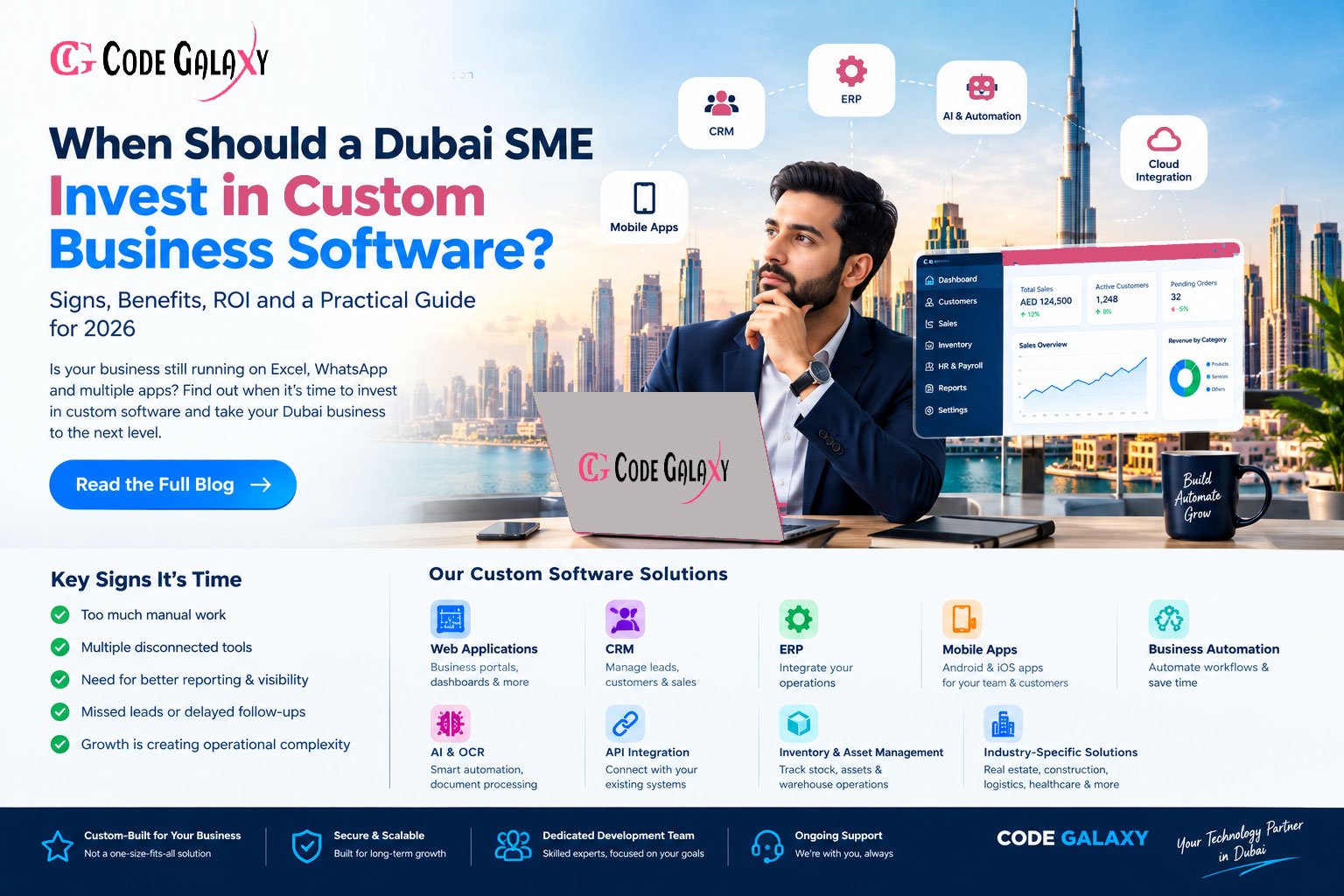
When Should a Dubai SME Invest in Custom Business Software
When Should a Dubai SME Invest in Custom Business Software?
A Practical Guide for Dubai Businesses in 2026
For many small and medium-sized businesses in Dubai, technology starts simply.
A business may begin with Excel spreadsheets, WhatsApp, email, accounting software, Google Sheets, and a few off-the-shelf applications.
That can work perfectly well in the early stages.
But as the business grows, these tools can become disconnected. Employees may enter the same information multiple times, managers may struggle to get accurate reports, customer follow-ups can be missed, and important business information can become scattered across different systems.
This is often the point where business owners start asking:
"Do we need custom software?"
The answer isn't necessarily yes.
Custom software makes sense when it solves a measurable business problem that existing tools cannot handle efficiently.
In this guide, we'll explain the signs that a Dubai SME may be ready for custom business software, what the investment should achieve, and how to decide whether now is the right time.
What Is Custom Business Software?
Custom business software is an application designed specifically around the processes, requirements, and workflows of a particular business.
Instead of changing your business process to fit an existing software package, the software is designed around the way your business operates.
For example, a Dubai construction company might need one platform connecting:
Projects → Sites → Labour → Attendance → Payroll → Materials → Inventory → Assets → Reports
A logistics company might need:
Customers → Shipments → Vehicles → Drivers → Delivery → Tracking → Billing
A real estate company might need:
Leads → Properties → Agents → Viewings → Follow-ups → Bookings → Commissions
These are very different workflows.
Custom software allows the business to create a centralized system around its actual requirements.
Is Custom Software Necessary for Every Dubai SME?
No.
If your business can operate efficiently with existing software, there may be no reason to build a custom platform.
The objective should not be:
"We need custom software because our competitors have it."
The better question is:
"Is our current way of working creating enough operational cost, inefficiency, risk, or missed opportunity to justify building something better?"
This distinction is important.
A 2026 study of 648 UAE SMEs found that digital adoption is already widespread, but only 8% of surveyed businesses were classified as having advanced digital maturity. The study also identified setup costs, skills gaps, subscription costs, and integration challenges among the barriers SMEs face.
That means digital transformation isn't simply about buying more software.
It is about using the right technology to solve the right business problems.
10 Signs Your Dubai SME May Be Ready for Custom Software
1. Your Team Relies Heavily on Excel
Excel is extremely useful, but problems can appear when it becomes the core operating system of the business.
For example:
-
Customer data in multiple spreadsheets
-
Inventory in separate Excel files
-
Employee attendance in another file
-
Sales reports prepared manually
-
Different versions of the same document
-
Managers requesting reports from employees
If employees spend hours every week maintaining spreadsheets instead of serving customers or managing operations, it may be time to consider a centralized system.
Example
Instead of:
Excel → Excel → WhatsApp → Email → Excel
you could have:
Business Management System → Centralized Database → Dashboard
2. You Are Using Too Many Separate Applications
A growing business may gradually accumulate different tools:
-
CRM
-
Accounting software
-
Inventory software
-
HR software
-
Email
-
WhatsApp
-
Spreadsheets
-
Project management tools
-
E-commerce platform
Each tool may work well individually.
The problem is often the gap between them.
Employees may repeatedly copy information from one system into another.
Custom software can integrate different workflows into a centralized platform or connect existing systems through APIs.
3. Your Employees Are Repeating the Same Tasks
Ask your team:
"What do you do every day that could be automated?"
You may discover tasks such as:
-
Copying customer information
-
Sending reminders
-
Creating reports
-
Updating inventory
-
Generating documents
-
Sending invoices
-
Checking payment status
-
Updating order status
-
Creating attendance reports
-
Sending WhatsApp notifications
These repetitive processes can often be automated.
For example:
New Customer
↓
Automatically create CRM record
↓
Assign sales employee
↓
Send WhatsApp confirmation
↓
Create follow-up task
↓
Notify sales manager
One automated workflow can replace several manual steps.
4. Your Business Has Grown Beyond Generic Software
Off-the-shelf software is designed for a broad market.
Your business may have specialized requirements.
For example, a construction company may need:
-
Site-wise labour
-
Contractor management
-
Site-specific wages
-
Attendance
-
Overtime
-
Material transfers
-
Asset tracking
-
Warehouse management
A generic application may not support the exact workflow.
If employees are constantly creating workarounds to make standard software fit your business, custom development may be worth considering.
5. Management Cannot Get Real-Time Information
Business owners and managers need visibility.
Can you answer questions such as:
-
How many active customers do we have?
-
What are today's sales?
-
Which leads need follow-up?
-
What inventory is available?
-
Which projects are over budget?
-
Which invoices are overdue?
-
Which employees are absent?
-
Which vehicles are currently active?
If answering these questions requires asking several employees to prepare spreadsheets, your business may benefit from a centralized dashboard.
Example dashboard
Sales
AED 245,000
Active Customers
1,248
Pending Orders
32
Outstanding Payments
AED 82,500
Active Projects
18
Information that previously required manual reporting can become available through a centralized system.
6. Your Business Is Losing Leads or Customers
A CRM can become especially valuable when the number of enquiries increases.
Without a proper system, leads can be scattered across:
-
WhatsApp
-
Phone calls
-
Email
-
Excel
-
Social media
-
Website forms
This can result in missed follow-ups.
A custom CRM can create a workflow such as:
Website Enquiry
↓
Lead Created
↓
Salesperson Assigned
↓
Follow-up Reminder
↓
Quotation
↓
Negotiation
↓
Won / Lost
↓
Customer
The business can then measure the entire sales pipeline.
7. Your Business Needs a Process That Existing Software Doesn't Support
This is one of the strongest reasons to consider custom development.
Imagine you operate a business with a unique workflow.
For example:
Customer Request
→ Approval
→ Site Assignment
→ Employee Assignment
→ Inventory Issue
→ Service Completion
→ Customer Confirmation
→ Invoice
→ Payment
If no existing software handles the complete workflow, you may have two options:
Option A: Adapt your business around existing software.
Option B: Build software around your business.
The right choice depends on cost, complexity, strategic importance, and expected return.
8. You Need Multiple User Roles and Approval Workflows
Growing companies often need different levels of access.
For example:
Admin
Full access.
Manager
Reports + approvals.
Sales Team
Customers + leads.
Warehouse
Inventory + transfers.
Employees
Attendance + assigned tasks.
Customers
Orders + invoices + support.
Custom software can provide role-based access so users only see the information and functionality they need.
9. You Want to Integrate AI or Automation Into Your Operations
AI is increasingly becoming part of business software.
Dubai launched a 2026 initiative focused on moving the private sector toward Agentic AI, while the UAE has also announced a framework targeting Agentic AI across 50% of government sectors and operations within two years.
For SMEs, this doesn't mean every business needs an AI agent.
Instead, start with practical use cases.
For example:
AI Customer Support
Customer asks a question
↓
AI understands the request
↓
Checks approved business information
↓
Provides response
AI Document Processing
Upload invoice
↓
OCR
↓
Extract supplier, amount and date
↓
Validate information
↓
Save to ERP
AI Sales Assistant
New lead
↓
Analyze enquiry
↓
Categorize lead
↓
Suggest follow-up
↓
Create CRM task
The important question is not:
"Where can we add AI?"
It is:
"Where can AI save our employees time or improve a business process?"
10. Your Business Is Growing Quickly
Growth creates complexity.
A company with five employees can sometimes operate through informal communication.
A company with:
-
20 employees
-
50 employees
-
100+ employees
may require structured processes.
As the business grows, you may need:
-
Centralized customer data
-
Employee management
-
Workflow automation
-
Role-based access
-
Inventory control
-
Reporting
-
Audit trails
-
API integrations
-
Mobile access
Investing in the right software before operational complexity becomes overwhelming can make future growth easier.
Custom Software Doesn't Have to Mean Building Everything From Scratch
This is an important point.
A business doesn't necessarily need a massive ERP platform on day one.
You can start with one problem.
For example:
Phase 1
CRM
Phase 2
Sales & quotations
Phase 3
Inventory
Phase 4
Purchase
Phase 5
Phase 6
This phased approach can reduce initial complexity and allow the business to validate each part of the system.
When Should You NOT Build Custom Software?
Custom development isn't always the right answer.
You may not need custom software if:
Your existing software already solves the problem
Don't rebuild something that works.
Your processes are still changing every month
First stabilize the workflow.
You have very few users
A simple SaaS product may be sufficient.
The expected benefit is very small
Don't spend AED 50,000 solving an AED 500 problem.
You haven't clearly identified the business problem
Technology should solve a defined problem.
How to Calculate Whether Custom Software Is Worth It
Think about the current cost of the problem.
For example:
Manual process
10 employees
×
1 hour/day
×
22 working days
=
220 employee-hours/month
If automation reduces that significantly, the business may recover substantial productive capacity.
But don't measure only employee time.
Also consider:
-
Missed leads
-
Data-entry errors
-
Delayed invoices
-
Inventory losses
-
Customer complaints
-
Management reporting time
-
Duplicate subscriptions
-
Operational mistakes
-
Delayed decision-making
Then compare the expected benefit with the development and maintenance cost.
A Simple ROI Framework
Use this calculation:
Current annual cost of inefficiency
minus
Expected annual savings/revenue improvement
=
Potential annual benefit
Then compare that with:
Software development + implementation + maintenance costs
The exact numbers will vary from business to business.
The goal isn't to prove that custom software is always profitable.
The goal is to determine whether the business problem is significant enough to justify investment.
Custom Software vs Off-the-Shelf Software
| Requirement | Off-the-Shelf | Custom Software |
|---|---|---|
| Quick setup | Usually easier | Usually takes longer |
| Initial cost | Often lower | Usually higher |
| Custom workflows | Limited by product | Designed around business |
| Integrations | Depends on APIs | Can be built specifically |
| Unique business processes | May require workarounds | Can be built directly |
| Scalability | Product-dependent | Designed around requirements |
| Ownership/control | Depends on provider | Greater control over custom application |
| Maintenance | Provider-dependent | Requires development/support |
| AI customization | Product-dependent | Can be built for specific workflows |
Neither approach is universally better.
The right choice depends on your business.
How Code Galaxy Can Help Dubai SMEs
At Code Galaxy, we develop custom business software around specific business requirements.
Our solutions can include:
CRM
Lead management, customer management, sales pipelines, follow-ups and reporting.
ERP
Sales, purchasing, inventory, warehouse, HR, payroll, assets and business operations.
Business Automation
Automated workflows, notifications, approvals, reports and integrations.
Mobile Applications
Customer, employee, field-service, delivery and business applications.
AI Solutions
AI assistants, document processing, OCR, automation and AI-powered workflows.
API Integration
Connect your existing business systems, payment services, communication platforms and other APIs.
Industry-Specific Software
Solutions for industries such as:
-
Real estate
-
Construction
-
Logistics
-
Healthcare
-
Retail
-
Trading
-
Professional services
-
Startups
Our Recommended Approach for Dubai SMEs
We don't recommend starting with a huge software project.
Instead, we suggest:
Step 1 — Identify the biggest business problem
What is currently costing you the most time or money?
Step 2 — Map the existing workflow
Understand how employees currently perform the process.
Step 3 — Identify automation opportunities
Determine what can be centralized, automated, or integrated.
Step 4 — Build the most valuable module first
Start with the part that provides the clearest business value.
Step 5 — Measure the result
Track:
-
Time saved
-
Errors reduced
-
Revenue opportunities
-
Operational efficiency
-
Customer experience
Step 6 — Expand gradually
Add additional modules only when they provide business value.
A Simple Decision Checklist
Ask yourself these 10 questions:
1. Are employees spending significant time on repetitive manual tasks?
2. Are we heavily dependent on Excel or spreadsheets?
3. Are we using multiple disconnected applications?
4. Are we manually transferring data between systems?
5. Are leads or customer follow-ups being missed?
6. Is management struggling to get real-time reports?
7. Do we have business processes that existing software cannot support?
8. Do we need multiple user roles and approval workflows?
9. Could automation or AI significantly improve one of our processes?
10. Can we clearly identify the financial or operational benefit of solving the problem?
If several answers are "yes," it may be worth evaluating a custom software solution.
The Right Time Isn't When Your Business Becomes Huge
A common misconception is:
"We'll build custom software when we're a large company."
In reality, the better time to investigate it is when your existing processes are starting to limit growth.
You don't need to automate everything.
Start with the process that creates the biggest operational problem.
For one business, that might be CRM.
For another, inventory.
For another, project management.
For another, employee management.
For another, customer support.
Final Thoughts
Custom software should not be treated simply as a technology expense.
For the right business, it can become part of the company's operating infrastructure.
The objective is simple:
Less manual work.
Better information.
Fewer disconnected systems.
More automation.
Better visibility.
A business platform that can grow with you.
Dubai is continuing to push toward deeper digital integration and AI-enabled operations. The direction of the market makes digital capability increasingly relevant, but SMEs still need to approach technology investment carefully and according to their actual business requirements.
Frequently Asked Questions
How much does custom software cost for a Dubai SME?
There is no single price because the cost depends on the number of modules, users, integrations, design requirements, mobile applications, AI features, security requirements, and project complexity.
A small business application can be very different from a complete ERP or enterprise platform.
How long does custom software development take?
A small application may take several weeks, while a larger CRM, ERP, SaaS platform, or multi-module business system may require several months.
A detailed timeline should be prepared after requirements analysis.
Can I start with only one module?
Yes. A phased approach can be useful for SMEs. You can begin with CRM, inventory, automation, or another high-priority business process and expand later.
Can custom software integrate with our existing systems?
Yes, where APIs or other suitable integration methods are available. Existing accounting, payment, communication, e-commerce, logistics, CRM, and other systems can potentially be connected.
Is custom software better than SaaS?
Not necessarily. SaaS can be a very good choice when it already solves your requirements. Custom software becomes more relevant when your workflows, integrations, reporting, or business requirements require significant customization.
Can Code Galaxy build software for Dubai businesses remotely?
Yes. Requirements meetings, design reviews, development, testing, demonstrations, deployment and support can be handled remotely, with other arrangements discussed according to project requirements.
Can you add AI to existing business software?
In many cases, yes. AI can potentially be integrated into an existing application through APIs, document processing, search, automation, assistants, or other suitable approaches.
Code Galaxy
Custom Software Development for Dubai Businesses
CRM | ERP | Mobile Apps | AI | Business Automation | API Integration
Build your software around your business — not your business around your software.
[Book a Free Consultation]