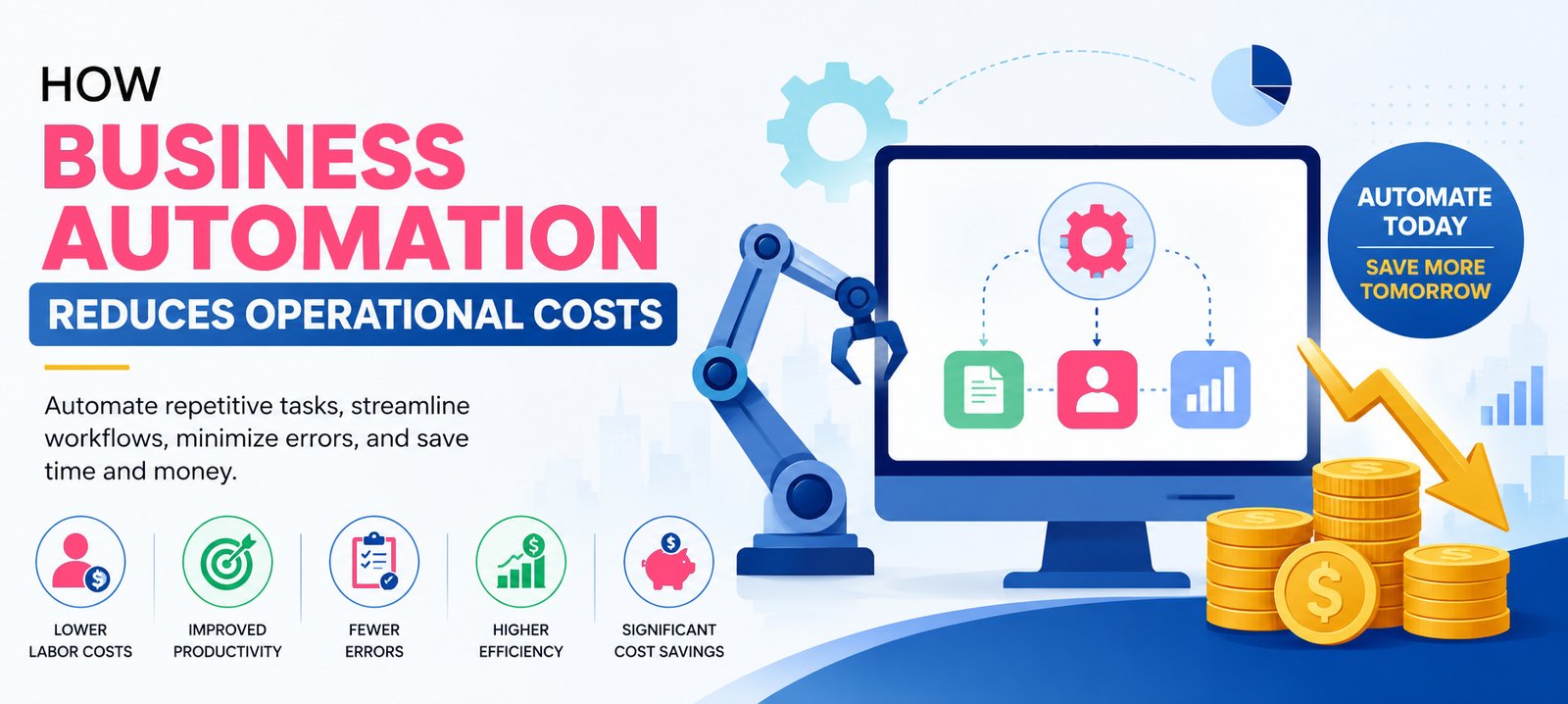
How Business Automation Reduces Operational Costs: A Complete Guide for Modern Businesses
In today's highly competitive business environment, organizations are constantly seeking ways to improve efficiency, reduce costs, and maximize profitability. One of the most effective strategies for achieving these goals is business automation. By automating repetitive tasks, streamlining workflows, and reducing human intervention, businesses can significantly lower operational costs while improving productivity and customer satisfaction.
Whether you run a startup, SME, or large enterprise, business automation can transform the way your organization operates. In this blog, we will explore how business automation helps reduce operational costs and why it has become an essential investment for modern businesses.
What is Business Automation?
Business automation refers to the use of technology, software, and digital tools to perform routine business processes with minimal human intervention. Automation can be applied across various departments, including:
- Sales and Marketing
- Human Resources
- Finance and Accounting
- Customer Support
- Inventory Management
- Project Management
- Operations and Administration
Common examples include CRM software, ERP systems, automated billing, chatbots, workflow management systems, and marketing automation platforms.
Why Businesses Are Adopting Automation
Organizations are increasingly embracing automation because manual processes often lead to:
- Higher labor costs
- Human errors
- Delayed operations
- Reduced productivity
- Poor customer experience
- Difficulty in scaling operations
Automation addresses these challenges by creating efficient, accurate, and scalable workflows.
1. Reduces Labor Costs
One of the most significant advantages of business automation is the reduction in labor expenses.
Many organizations spend substantial resources on repetitive administrative tasks such as:
- Data entry
- Invoice generation
- Attendance management
- Report creation
- Customer follow-ups
Automation tools can perform these tasks automatically, reducing the need for extensive manual effort.
Example:
A company using an automated CRM can send customer follow-up emails, reminders, and quotations without requiring employees to manually manage every interaction.
Cost Savings:
- Reduced staffing requirements for repetitive tasks
- Better allocation of the workforce to strategic activities
- Lower overtime expenses
2. Minimizes Human Errors
Manual processes often lead to mistakes that can be costly.
Common errors include:
- Incorrect invoices
- Data duplication
- Inventory discrepancies
- Miscommunication
- Compliance issues
Automated systems follow predefined rules and workflows, ensuring consistency and accuracy.
Benefits:
- Reduced rework costs
- Improved data accuracy
- Fewer customer complaints
- Better compliance management
3. Improves Employee Productivity
Employees spend a large portion of their time performing repetitive and low-value tasks.
Business automation enables employees to focus on:
- Business development
- Customer relationship management
- Strategic planning
- Innovation
- Revenue-generating activities
When employees are freed from routine work, overall productivity increases significantly.
Example:
Automated workflow approvals can reduce processing time from days to minutes.
4. Enhances Customer Service Efficiency
Customer satisfaction directly impacts business growth and profitability.
Automation helps businesses provide:
- Instant responses
- 24/7 support
- Faster issue resolution
- Personalized communication
Automation Tools:
- AI Chatbots
- Customer Relationship Management (CRM)
- Automated Ticketing Systems
- Email Automation Platforms
Cost Reduction:
- Lower customer support staffing requirements
- Reduced response times
- Improved customer retention
5. Reduces Operational Delays
Manual approvals and paperwork often create bottlenecks that slow down business operations.
Automation accelerates workflows by:
- Automatically routing approvals
- Sending reminders
- Tracking task completion
- Generating real-time notifications
Result:
Faster business processes mean reduced operational costs and increased efficiency.
6. Optimizes Inventory Management
For businesses dealing with products and inventory, automation can significantly reduce losses.
Automated inventory systems help:
- Track stock levels in real-time
- Generate reorder alerts
- Prevent overstocking
- Reduce stock shortages
Benefits:
- Lower storage costs
- Reduced inventory wastage
- Better demand forecasting
7. Lowers Paperwork and Administrative Expenses
Traditional business operations involve significant spending on:
- Paper
- Printing
- Storage
- Documentation
- Courier services
Digital automation eliminates many of these expenses through:
- Electronic records
- Digital signatures
- Cloud storage
- Online approvals
Additional Benefits:
- Eco-friendly operations
- Easy document retrieval
- Improved data security
8. Better Financial Management
Financial automation provides businesses with greater control over cash flow and expenses.
Automation tools can handle:
- Invoice generation
- Payment reminders
- Expense tracking
- Payroll processing
- Financial reporting
Cost Savings:
- Reduced accounting workload
- Improved financial accuracy
- Faster payment collections
9. Enables Business Scalability Without Major Cost Increases
As businesses grow, operational complexity increases.
Without automation, companies often need to hire additional employees to manage increased workloads.
Automation allows businesses to scale operations while keeping costs under control.
Example:
An e-commerce business can process thousands of orders automatically without proportionally increasing administrative staff.
Advantage:
Higher revenue growth with controlled operational expenses.
10. Provides Data-Driven Decision Making
Modern automation systems generate real-time reports and analytics.
Business leaders can access valuable insights such as:
- Sales performance
- Customer behavior
- Employee productivity
- Financial trends
- Operational efficiency
Better decisions lead to:
- Reduced waste
- Optimized resource allocation
- Increased profitability
Industries Benefiting from Business Automation
Healthcare
- Patient management
- Appointment scheduling
- Billing automation
Manufacturing
- Production planning
- Inventory management
- Quality control
Real Estate
- Lead management
- Property tracking
- Customer communication
Education
- Student enrollment
- Attendance tracking
- Fee management
Finance
- Loan processing
- Compliance reporting
- Risk assessment
Retail & E-commerce
- Order management
- Customer support
- Inventory control
Key Business Automation Tools
Popular automation solutions include:
- CRM Software
- ERP Systems
- HRMS Platforms
- Marketing Automation Tools
- Accounting Software
- Workflow Automation Platforms
- AI Chatbots
- Inventory Management Systems
Selecting the right solution depends on your business size, industry, and operational requirements.
ROI of Business Automation
Businesses implementing automation often experience:
✔ 30–70% reduction in manual work
✔ Faster operational processes
✔ Improved customer satisfaction
✔ Lower administrative costs
✔ Increased employee productivity
✔ Better scalability
✔ Higher profitability
The return on investment (ROI) is typically achieved within months through cost savings and improved operational efficiency.
Conclusion
Business automation is no longer a luxury—it's a necessity for organizations aiming to stay competitive in the digital era. By automating repetitive tasks, reducing human errors, optimizing workflows, and improving resource utilization, businesses can dramatically lower operational costs while enhancing overall performance.
Companies that invest in automation today are better positioned to scale efficiently, improve customer experiences, and achieve sustainable long-term growth.
If your organization is still relying on manual processes, now is the perfect time to explore automation solutions and unlock significant cost savings.