Digital Marketing Mistakes to Avoid for Business Growth
Why Is Your Digital Marketing Not Delivering the Expected Results?
Digital marketing has become one of the most important parts of modern business growth. Whether you operate a small local business, a startup, a manufacturing company, an educational institution, a healthcare organisation, or an established enterprise, having a strong online presence is essential for reaching potential customers.
Today, customers use Google to search for products and services, explore social media platforms to discover brands, read online reviews before making decisions, and compare different businesses before choosing one.
This creates enormous opportunities for businesses to reach new audiences, generate qualified leads, increase sales, and build long-term customer relationships.
However, there is one major problem: Many businesses invest in digital marketing but fail to achieve meaningful business results.
Some companies spend money on Google Ads but receive very few enquiries. Others regularly publish social media posts but struggle to convert followers into customers. Some businesses have professionally designed websites but receive almost no organic traffic from search engines.
Why does this happen?
In most cases, the problem is not digital marketing itself. The problem is the way digital marketing is planned, implemented, managed, and measured.
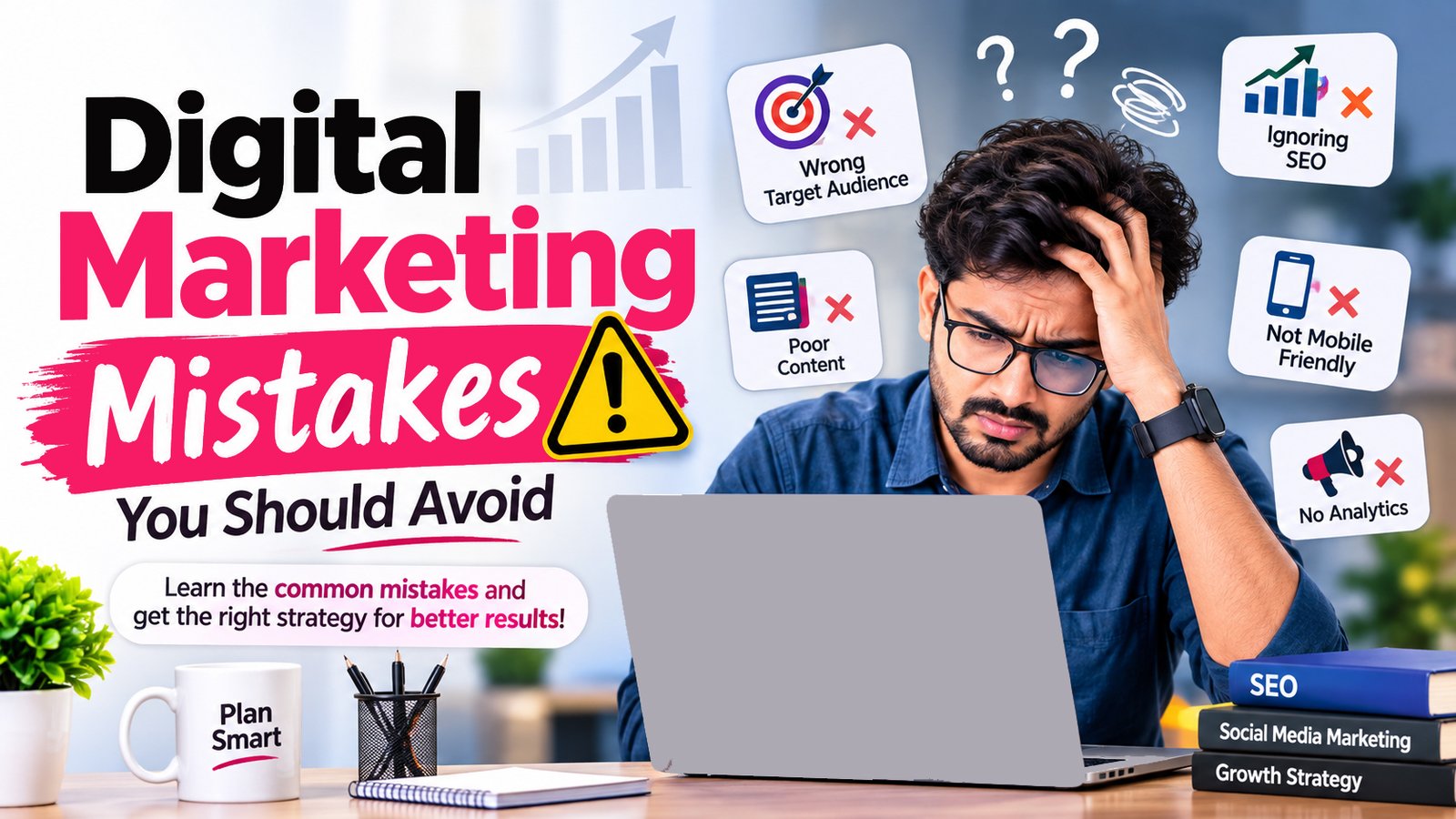
Businesses often make basic mistakes such as starting campaigns without a strategy, targeting the wrong audience, ignoring search engine optimisation (SEO), publishing content without a purpose, and failing to track conversions.
Digital marketing is not simply about maintaining social media accounts or spending money on advertisements. It is a complete business development process that connects brand awareness, customer engagement, lead generation, sales conversion, and customer retention.
In this guide, we will explore 15 common digital marketing mistakes businesses make, why these mistakes affect business growth, and how to avoid them with a practical digital marketing strategy.
1. Starting Digital Marketing Without a Proper Strategy
One of the biggest mistakes businesses make is starting digital marketing activities without defining a clear strategy.
Many business owners begin by creating Facebook and Instagram pages, publishing promotional graphics, running advertisements, or hiring a marketing agency without first understanding what they actually want to achieve.
Digital marketing should never begin with random activities. It should begin with business objectives.
For example, a manufacturing company may want to generate B2B enquiries, while a restaurant may want to attract local customers. An educational institution may want student admissions, whereas an e-commerce business may focus on increasing online purchases.
Each business requires a different marketing approach.
Common mistakes:
-
Running advertisements without defining campaign objectives.
-
Publishing random social media content.
-
Selecting marketing channels without understanding the audience.
-
Not defining a marketing budget.
-
Expecting immediate results without a structured plan.
How to avoid this mistake:
Before starting any campaign, define:
-
What are your primary business objectives?
-
Who are your ideal customers?
-
Which geographical locations do you want to target?
-
Which digital platforms do your customers use?
-
What is your monthly marketing budget?
-
How will you measure campaign performance?
Prepare a digital marketing roadmap covering website development, SEO, social media, paid advertising, content marketing, and lead management.
A clear strategy helps businesses avoid unnecessary expenses and focus on activities that support actual business objectives.
2. Not Understanding the Target Audience
Another major mistake is trying to promote products and services to everyone.
Every business has a specific customer segment. When marketing campaigns are designed without understanding customer requirements, interests, purchasing behaviour, and problems, marketing communication becomes ineffective.
For example, promoting premium industrial software to general social media users may not generate valuable enquiries. Similarly, advertising a local restaurant across an entire country may waste advertising resources.
Common mistakes:
-
Targeting everyone instead of a specific customer group.
-
Ignoring customer requirements and purchasing behaviour.
-
Not understanding customer problems.
-
Selecting incorrect locations for advertisements.
-
Using the same marketing message for different audiences.
How to avoid this mistake:
Develop detailed customer personas.
A customer persona should include:
-
Age group and profession.
-
Geographical location.
-
Business category or industry.
-
Income or purchasing capacity, where relevant.
-
Interests and requirements.
-
Common problems and expectations.
-
Preferred communication platforms.
For B2B companies, identify decision-makers such as business owners, directors, procurement managers, marketing managers, and IT managers.
Understanding your audience helps create relevant marketing messages that attract people who are more likely to become customers.
3. Ignoring Website Development and Website Optimization
A website is one of the most important assets of a business's digital presence.
Social media platforms help businesses reach potential customers, but a professional website provides an independent platform where visitors can learn about services, understand the company's expertise, explore projects, and submit enquiries.
Unfortunately, many businesses treat website development as a one-time activity.
They launch a website and rarely update it, improve its performance, or evaluate its user experience.
Common website mistakes:
-
Slow website loading speed.
-
Poor mobile responsiveness.
-
Outdated website design.
-
Complicated navigation.
-
Missing service descriptions.
-
No clear contact information.
-
Broken links and incomplete pages.
-
No visible call-to-action buttons.
-
Poorly designed enquiry forms.
-
Missing trust signals and customer testimonials.
How to avoid this mistake:
Invest in a professionally developed, mobile-friendly, and conversion-focused website.
Your website should include:
-
A clear homepage explaining your business.
-
Detailed service or product pages.
-
Company information and business credentials.
-
Relevant project portfolios or case studies.
-
Genuine customer testimonials.
-
Contact forms and WhatsApp integration.
-
Clear calls to action.
-
Proper technical SEO implementation.
-
Website analytics and conversion tracking.
Remember, a website should not simply look attractive. It should guide visitors towards taking meaningful actions, such as requesting a quotation, booking an appointment, making a purchase, or contacting your business.
4. Depending Only on Social Media Marketing
Social media platforms such as Facebook, Instagram, LinkedIn, and YouTube offer excellent opportunities for brand awareness and customer engagement.
However, depending entirely on social media is a risky marketing approach.
Some businesses believe that regularly publishing graphics, reels, and promotional videos is enough to establish their online presence.
The reality is that social media visibility does not automatically generate sales.
Your business may receive thousands of views but still struggle to generate qualified enquiries.
Common mistakes:
-
Depending only on Facebook or Instagram.
-
Ignoring Google search visibility.
-
Not developing a business website.
-
Focusing only on followers and likes.
-
Not directing social media visitors towards relevant business pages.
How to avoid this mistake:
Develop a multi-channel digital marketing strategy.
Different platforms serve different purposes:
-
Google Search: Reaches people actively looking for products and services.
-
Facebook: Supports community engagement and customer acquisition.
-
Instagram: Helps build visual identity and brand awareness.
-
LinkedIn: Supports B2B marketing and professional networking.
-
YouTube: Helps educate customers through videos and demonstrations.
-
Email Marketing: Supports customer communication and retention.
Choose platforms according to your target audience and business objectives rather than trying to maintain every platform without a clear purpose.
5. Publishing Social Media Content Without a Content Strategy
Content marketing is an essential part of digital marketing. However, publishing content regularly without understanding what your audience wants to see is a common mistake.
Many businesses repeatedly publish promotional messages such as:
-
Contact us today.
-
Buy our products.
-
We provide the best services.
-
Get special discounts.
-
Visit our website.
Although promotional content is important, customers also want useful information, practical solutions, industry insights, and educational content.
Common mistakes:
-
Publishing random graphics.
-
Repeating promotional messages.
-
Copying competitors' content.
-
Not maintaining a content calendar.
-
Ignoring audience engagement.
-
Publishing content without a clear call to action.
How to avoid this mistake:
Create a structured monthly content calendar.
Consider dividing your content into four categories:
Educational Content: Share industry information, useful tips, tutorials, and answers to common customer questions.
Promotional Content: Highlight your products, services, offers, and business advantages.
Engagement Content: Publish polls, questions, interactive posts, and customer discussions.
Trust-Building Content: Share testimonials, customer success stories, completed projects, company achievements, and behind-the-scenes activities.
A balanced content strategy helps businesses build credibility instead of continuously asking customers to purchase something.
6. Ignoring Search Engine Optimization (SEO)
Search Engine Optimization is one of the most valuable long-term digital marketing activities.
When potential customers search for products or services on Google, they usually explore the results that appear relevant to their requirements.
If your website does not appear for relevant search queries, you may lose potential customers to competitors who have invested in SEO.
Unfortunately, many businesses consider SEO only after their website has been developed or when paid advertising becomes expensive.
Common SEO mistakes:
-
Not conducting proper keyword research.
-
Using incorrect keywords.
-
Missing or duplicate meta titles and descriptions.
-
Publishing thin or duplicate content.
-
Ignoring internal linking.
-
Not optimizing website images.
-
Poor website structure.
-
Ignoring technical SEO.
-
Not creating relevant service and location pages.
-
Failing to publish informative blog articles.
How to avoid this mistake:
Develop an ongoing SEO strategy that includes three important areas.
On-Page SEO
Optimize individual website pages using relevant keywords, meaningful headings, informative content, descriptive URLs, internal links, and appropriate meta information.
Technical SEO
Ensure that search engines can access and understand your website. Review website speed, mobile usability, indexing, XML sitemaps, robots.txt, canonical URLs, and broken links.
Off-Page SEO
Build your website's authority through relevant industry mentions, quality backlinks, genuine business directories, and digital PR activities.
For local businesses, Local SEO is equally important. Maintain an accurate Google Business Profile, collect genuine customer reviews, and provide consistent business information.
SEO is a continuous process. It requires regular monitoring, content improvements, and technical maintenance.
7. Running Paid Advertisements Without Proper Planning
Google Ads and Meta Ads can help businesses reach potential customers faster. However, poorly planned campaigns can consume marketing budgets without generating meaningful business results.
One common mistake is running advertisements simply because competitors are advertising or because a business wants immediate visibility.
Advertising without understanding the audience, campaign objectives, and conversion journey often results in wasted expenditure.
Common mistakes:
-
Running advertisements without defining objectives.
-
Selecting broad or irrelevant audiences.
-
Using poor-quality advertisement creatives.
-
Sending visitors to irrelevant website pages.
-
Not setting up conversion tracking.
-
Ignoring lead quality.
-
Not testing different advertisements.
-
Increasing budgets without analysing performance.
How to avoid this mistake:
Before launching paid campaigns:
-
Define the campaign objective.
-
Research the target audience.
-
Select relevant keywords or audience segments.
-
Prepare attractive and relevant advertising creatives.
-
Create dedicated landing pages.
-
Configure conversion tracking.
-
Establish an appropriate advertising budget.
-
Monitor campaign performance.
-
Test different advertisements and landing pages.
-
Optimize campaigns based on actual results.
Do not measure advertising success only through impressions and clicks. Focus on qualified leads, purchases, customer acquisition costs, and revenue wherever measurable.
8. Ignoring Google Business Profile and Local SEO
For businesses that depend on local customers, Google Business Profile can be an important source of visibility and enquiries.
When someone searches for a nearby service, Google may display local business listings along with relevant business information, locations, reviews, and contact details.
However, many businesses either do not create their business profiles or fail to maintain them properly.
Common mistakes:
-
Incorrect business name, address, or phone number.
-
Missing business categories.
-
No updated photographs.
-
Incomplete business descriptions.
-
Not responding to customer reviews.
-
Ignoring business updates.
-
Not maintaining consistent contact information.
How to avoid this mistake:
Optimize your Google Business Profile with accurate business information.
Regularly update photographs, business hours, services, contact details, and relevant posts.
Encourage satisfied customers to share honest reviews and respond professionally to customer feedback.
For businesses serving specific cities or regions, create useful location-focused website content rather than publishing repetitive pages with only city names changed.
9. Not Tracking Leads and Conversions
One of the most expensive digital marketing mistakes is failing to understand where business enquiries are coming from.
Imagine a company spends money on Google Ads, Facebook campaigns, SEO, and social media marketing.
It receives 100 enquiries in a month but cannot identify which channel generated the most qualified prospects.
How can that company decide where to invest its next marketing budget?
Without proper tracking, businesses make marketing decisions based on assumptions instead of reliable information.
Common mistakes:
-
Not tracking website form submissions.
-
Not measuring phone call enquiries.
-
Not identifying lead sources.
-
Not tracking WhatsApp enquiries.
-
Not maintaining enquiry records.
-
Not monitoring lead conversion rates.
How to avoid this mistake:
Implement proper tracking and lead management systems.
Useful tools include:
-
Google Analytics 4 for website traffic and user behaviour.
-
Google Search Console for organic search performance.
-
Google Ads conversion tracking for advertising outcomes.
-
Meta Pixel and Conversions API, where appropriate, for Meta campaign measurement.
-
CRM software for managing enquiries and sales pipelines.
-
UTM parameters for identifying campaign traffic sources.
Create a structured lead tracking process so that your business can understand how visitors become enquiries and how enquiries become customers.
10. Ignoring Customer Reviews and Online Reputation
Customers increasingly research businesses before making purchasing decisions.
They may visit your website, explore your social media pages, check Google reviews, and compare your business with competitors.
A poor online reputation can reduce customer confidence, even when your products or services are good.
Common mistakes:
-
Ignoring negative customer reviews.
-
Not responding to customer feedback.
-
Failing to encourage genuine reviews.
-
Publishing unverified testimonials.
-
Not addressing customer complaints professionally.
How to avoid this mistake:
Develop a proper online reputation management process.
Ask satisfied customers for honest feedback, respond to reviews professionally, address genuine complaints, and use customer feedback to improve your services.
Never purchase fake reviews or misrepresent customer experiences.
Remember, building trust is a long-term process, and every customer interaction contributes to your business reputation.
11. Ignoring Email Marketing and WhatsApp Marketing
Many businesses concentrate on attracting new customers but forget about the people who have already shown interest in their products or services.
A customer may visit your website, request a quotation, ask a question, or contact your business through social media.
If there is no follow-up communication, that potential opportunity may be lost.
Common mistakes:
-
Not following up with interested customers.
-
Ignoring existing customer databases.
-
Sending irrelevant promotional emails.
-
Not responding to enquiries quickly.
-
Using manual processes for repetitive communication.
-
Not maintaining customer communication records.
How to avoid this mistake:
Use email marketing and WhatsApp Business tools to improve customer communication.
You can implement:
-
Automated enquiry acknowledgements.
-
Appointment reminders.
-
Quotation follow-ups.
-
Product and service updates.
-
Customer onboarding messages.
-
Permission-based promotional campaigns.
-
Post-purchase communication.
-
Customer feedback requests.
Automation should support useful and timely communication, not overwhelm customers with unnecessary messages.
Always respect customer consent, applicable privacy requirements, and messaging-platform policies.
12. Maintaining Inconsistent Branding Across Digital Platforms
Branding is not limited to having a logo. It includes your business identity, communication style, visual presentation, customer experience, and overall market positioning.
Many businesses use different logos, colours, fonts, business descriptions, and communication styles across their website and social media platforms.
This creates confusion and reduces brand recognition.
Common mistakes:
-
Using different logos on different platforms.
-
Changing brand colours frequently.
-
Maintaining inconsistent business descriptions.
-
Using low-quality promotional graphics.
-
Communicating different brand messages.
-
Not maintaining a professional visual identity.
How to avoid this mistake:
Develop a simple brand guideline that defines:
-
Official logo and logo variations.
-
Brand colours.
-
Typography.
-
Image and graphic styles.
-
Business description.
-
Brand voice and communication style.
-
Standard contact information.
Maintain the same brand identity across your website, social media, email campaigns, advertisements, and business listings.
Consistency helps customers recognize and remember your business.
13. Expecting Immediate Results From Digital Marketing
Digital marketing is not an overnight solution.
Some businesses expect to receive hundreds of enquiries within a few days of launching a website or starting SEO activities.
When immediate results do not appear, they change their strategy, stop campaigns, or assume that digital marketing does not work.
Different marketing channels require different timeframes.
Paid advertisements can generate traffic relatively quickly, but profitable campaigns still require testing and optimization. SEO generally requires sustained effort and may take months to show meaningful progress, depending on competition, website condition, and other factors.
Common mistakes:
-
Expecting immediate Google rankings.
-
Stopping SEO too early.
-
Changing advertising strategies frequently.
-
Expecting every social media post to generate leads.
-
Judging campaigns without sufficient data.
How to avoid this mistake:
Set realistic expectations and establish a structured review schedule.
Evaluate short-term campaign performance separately from long-term brand and organic growth.
For example:
-
Weekly: Review advertisements, enquiries, and campaign issues.
-
Monthly: Evaluate website traffic, lead quality, and content performance.
-
Quarterly: Review overall marketing strategy, budget allocation, and business outcomes.
Consistency and continuous improvement are more valuable than frequently changing direction without proper analysis.
14. Ignoring Competitor Analysis
Your business does not operate in isolation. Customers have multiple options, and competitors are constantly trying to attract the same audience.
Ignoring competitor activities can result in missed opportunities, weak positioning, and ineffective marketing campaigns.
Common mistakes:
-
Not analysing competitors' websites.
-
Ignoring competitor keywords.
-
Not studying their service offerings.
-
Failing to understand market positioning.
-
Not identifying customer expectations.
-
Copying competitor strategies without understanding their business model.
How to avoid this mistake:
Conduct regular competitor research.
Analyse:
-
Competitor website structure and user experience.
-
Organic search visibility and keyword opportunities.
-
Social media content and engagement.
-
Advertising messages and offers.
-
Customer reviews and feedback.
-
Service positioning and pricing information, where publicly available.
-
Content marketing and backlink opportunities.
The objective is not to copy competitors. It is to identify gaps in the market and develop a stronger value proposition.
15. Focusing on Likes and Followers Instead of Business ROI
One of the biggest misunderstandings in digital marketing is treating social media engagement as the ultimate measure of business success.
A business may have thousands of followers, hundreds of likes, and impressive post reach but still generate very few paying customers.
These numbers can help measure visibility and engagement, but they do not necessarily indicate business growth.
Common mistakes:
-
Focusing only on followers.
-
Celebrating impressions without evaluating enquiries.
-
Ignoring customer acquisition costs.
-
Not calculating advertising returns.
-
Failing to connect marketing activities with revenue.
-
Continuing campaigns that generate low-quality leads.
How to avoid this mistake:
Identify meaningful Key Performance Indicators (KPIs) according to your business objectives.
| KPI | What it measures |
|---|---|
| Website Traffic | Number of website visitors |
| Organic Traffic | Visitors from unpaid search results |
| Qualified Leads | Relevant potential customers |
| Cost Per Lead (CPL) | Cost of generating an enquiry |
| Conversion Rate | Percentage of visitors or leads completing a desired action |
| Customer Acquisition Cost (CAC) | Cost of acquiring a customer |
| Return on Ad Spend (ROAS) | Revenue attributed to advertising relative to ad spend |
| Customer Retention Rate | Ability to retain customers |
The most important question is not how many people saw your advertisement. It is how effectively your marketing investment contributes to business objectives.
What Is the Correct Digital Marketing Process for Any Business?
Avoiding mistakes is only one part of successful digital marketing. Businesses also need a systematic process that connects every marketing activity with the next stage of customer acquisition.
A successful digital marketing process should follow these eight stages.
Step 1: Business Analysis and Goal Identification
Begin by understanding the business, its services, products, target market, existing customers, and growth objectives.
Identify whether the business wants to increase brand awareness, generate enquiries, improve online sales, attract local customers, or expand into new markets.
Define measurable objectives before selecting marketing channels.
Step 2: Market Research and Audience Identification
Conduct market research to understand customer expectations, industry trends, competitors, and market opportunities.
Create customer personas and identify the problems your products or services can solve.
This research becomes the foundation for marketing communication and campaign targeting.
Step 3: Build a Strong Digital Foundation
Establish the essential digital infrastructure.
This includes:
-
Professional website development.
-
Mobile responsiveness.
-
Website speed optimization.
-
Search engine optimization.
-
Google Business Profile.
-
Social media business profiles.
-
Analytics and conversion tracking.
-
Clear contact and enquiry channels.
Your digital foundation should be ready before investing heavily in advertising.
Step 4: Develop a Content and Marketing Strategy
Create a content calendar based on customer interests and business objectives.
Plan educational articles, social media posts, promotional campaigns, videos, case studies, and other relevant content.
Develop different messages for different stages of the customer journey.
Step 5: Generate Traffic Through Multiple Channels
Use a combination of organic and paid marketing channels.
These may include:
-
Search Engine Optimization.
-
Google Ads.
-
Facebook and Instagram Ads.
-
LinkedIn Marketing.
-
YouTube Marketing.
-
Content Marketing.
-
Email Marketing.
-
Local SEO.
Select channels according to customer behaviour, budget, and campaign objectives.
Step 6: Convert Visitors Into Qualified Leads
Generating traffic is not the final objective.
Create an effective conversion process through dedicated landing pages, enquiry forms, phone calls, WhatsApp communication, appointment booking, and clear calls to action.
Make it easy for potential customers to understand your offering and contact your business.
Step 7: Manage Leads and Automate Follow-Ups
Implement a CRM system to record enquiries, track customer interactions, assign follow-up responsibilities, and monitor sales opportunities.
Use appropriate automation to send acknowledgement messages, reminders, and follow-up communications.
This helps businesses reduce missed enquiries and improve the customer experience.
Step 8: Measure, Analyse, and Improve
Regularly evaluate campaign performance and compare results with your original objectives.
Identify which channels generate qualified leads, which landing pages convert visitors, and where customers leave the conversion journey.
Improve campaigns using real performance data rather than assumptions.
Digital marketing should operate as a continuous improvement cycle, not as a collection of disconnected activities.
Digital Marketing Channels and Their Business Objectives
Not every digital marketing channel serves the same purpose. Understanding the role of each channel helps businesses allocate their resources more effectively.
| Digital Marketing Channel | Primary Business Objective |
|---|---|
| Website Development | Build credibility and generate enquiries |
| SEO | Increase organic search visibility |
| Social Media Marketing | Build brand awareness and engagement |
| Google Ads | Reach customers actively searching for solutions |
| Meta Ads | Reach relevant audiences and generate demand |
| Content Marketing | Educate customers and build trust |
| Email Marketing | Maintain customer relationships |
| WhatsApp Marketing | Improve customer communication |
| CRM | Organize and manage leads |
| Analytics | Measure performance and identify improvements |
A successful marketing strategy combines these channels according to the business model instead of investing equally in every platform.
A Practical 30-Day Digital Marketing Action Plan
Businesses that want to improve their digital marketing can begin with a structured 30-day action plan.
Week 1: Research and Planning
-
Analyse the existing digital presence.
-
Identify target customers.
-
Study competitors.
-
Define business and marketing objectives.
-
Establish the marketing budget.
-
Select relevant digital marketing channels.
Week 2: Digital Foundation
-
Audit the existing website.
-
Improve website design and mobile responsiveness.
-
Review SEO structure.
-
Optimize Google Business Profile.
-
Update social media profiles.
-
Configure analytics and conversion tracking.
Week 3: Marketing Execution
-
Prepare a monthly content calendar.
-
Publish educational and promotional content.
-
Start relevant SEO activities.
-
Create landing pages.
-
Launch targeted advertising campaigns.
-
Set up enquiry management and follow-up processes.
Week 4: Performance Analysis
-
Review website traffic.
-
Analyse campaign performance.
-
Evaluate enquiry quality.
-
Identify conversion problems.
-
Review customer feedback.
-
Optimize content and advertisements.
-
Prepare the next month's marketing plan.
This 30-day plan establishes a starting framework. Meaningful long-term improvement requires ongoing implementation, testing, and optimization.
Frequently Asked Questions About Digital Marketing Mistakes
1. What is the most common digital marketing mistake businesses make?
The most common mistake is starting digital marketing without a clear strategy. Businesses often spend money on advertisements and social media activities without defining their target audience, objectives, budget, or performance indicators.
2. Why is digital marketing not generating leads for my business?
Several factors may contribute to poor lead generation, including incorrect audience targeting, weak website content, poor landing page design, ineffective advertisements, lack of trust, and missing conversion tracking.
Businesses should analyse the complete customer journey to identify where potential customers are being lost.
3. Is having a website enough for successful digital marketing?
No. A website is an important foundation, but it needs to be supported by SEO, content marketing, social media, relevant advertising, and conversion optimization.
A website without a traffic generation and lead conversion strategy may receive very few enquiries.
4. Should small businesses invest in SEO or paid advertising?
Both can support business growth, but the right choice depends on business objectives and available resources.
Paid advertising can help generate immediate visibility, while SEO supports long-term organic visibility. Many businesses benefit from combining both approaches.
5. How much should a business spend on digital marketing?
There is no fixed marketing budget suitable for every business.
The budget depends on industry competition, business objectives, geographical targeting, advertising costs, and expected customer acquisition costs.
Businesses should begin with a realistic budget, measure performance, and increase investment based on actual results.
6. How long does digital marketing take to show results?
The timeline depends on the marketing channel and business conditions.
Paid advertising may generate traffic and enquiries relatively quickly, whereas SEO and organic brand building generally require sustained effort.
Businesses should evaluate progress through appropriate short-term and long-term performance indicators.
7. Which digital marketing tools should businesses use?
Depending on their requirements, businesses can use Google Analytics 4, Google Search Console, Google Ads, Meta Business Suite, CRM platforms, email marketing tools, and social media scheduling applications.
The objective should be to select tools that support business processes rather than adopting unnecessary software.
8. Why is CRM important in digital marketing?
CRM software helps businesses organize customer information, record enquiries, track follow-ups, manage sales opportunities, and monitor lead conversion.
It connects marketing activities with the sales process and reduces the chances of losing potential customers.
Conclusion: Successful Digital Marketing Starts With the Right Process
Digital marketing has the potential to transform businesses, but simply being present online does not guarantee growth.
Businesses need to understand their customers, establish a strong digital foundation, publish valuable content, improve search visibility, run well-planned campaigns, manage enquiries, and continuously measure performance.
The biggest mistake is treating digital marketing as an isolated promotional activity instead of considering it an integrated business growth process.
Every stage matters. A successful advertisement needs a relevant landing page. A website needs a traffic generation strategy. Traffic needs an effective conversion process. Generated leads need proper follow-ups. And every marketing activity needs performance measurement.
The ultimate goal of digital marketing is not just to increase online visibility. It is to turn visibility into opportunities, opportunities into customers, and customers into long-term business relationships.