Average Website Development Cost in India in 2026: Complete Pricing Guide
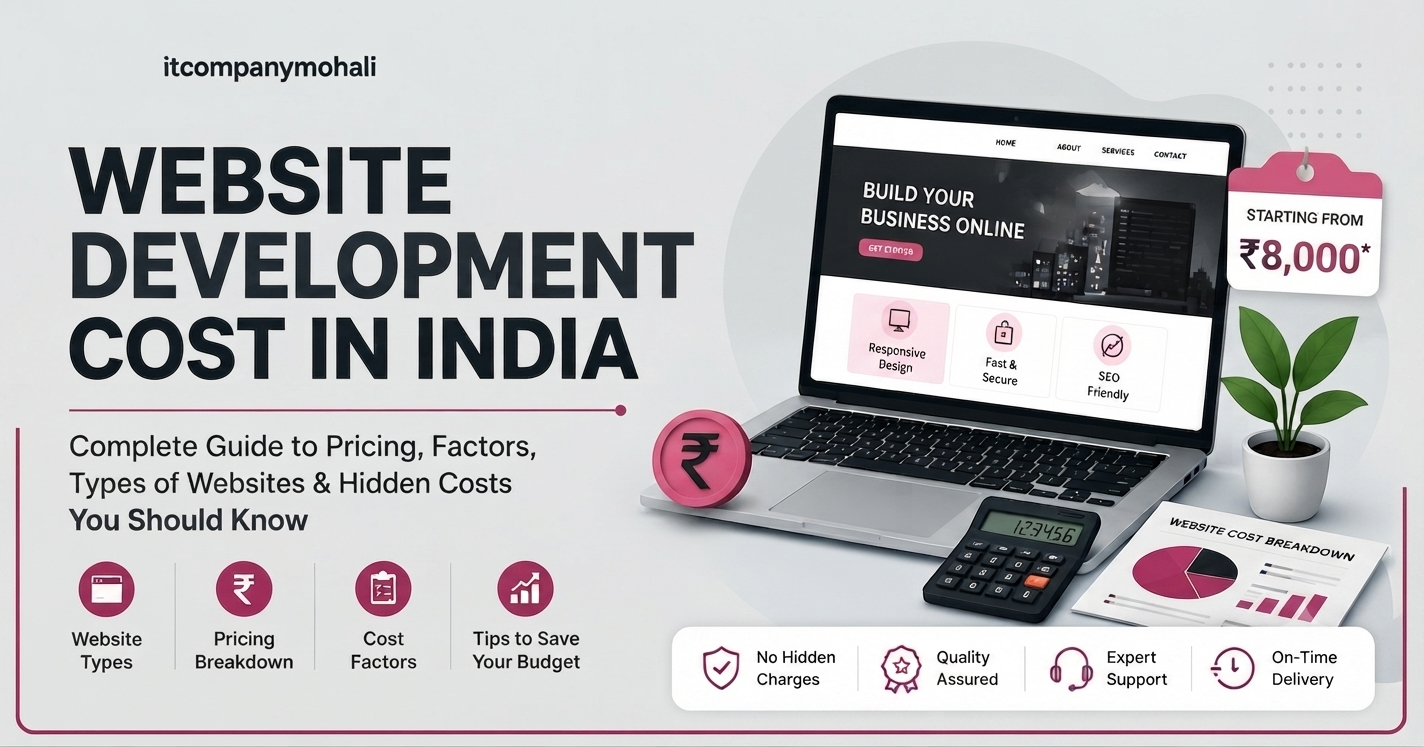
How much does it cost to build a website in India in 2026?
This is one of the first questions businesses ask when planning a new website. The answer, however, is not a single fixed number.
A simple landing page may cost a few thousand rupees, while a professionally designed business website can cost ₹40,000–₹1,50,000 or more. Ecommerce websites, custom web applications, marketplaces, and enterprise platforms can require significantly larger budgets.
Current 2026 market guides show wide price ranges because website projects differ significantly in their design, functionality, technology, integrations, content requirements, and ongoing support.
In this guide, we explain the average website development cost in India in 2026, what you get at different budget levels, and the factors that determine the final price.
Average Website Development Cost in India in 2026
Here is a practical overview of commonly quoted 2026 market ranges:
| Website Type | Approximate Development Cost |
|---|---|
| Landing Page | ₹10,000 – ₹40,000 |
| Basic Business Website | ₹20,000 – ₹60,000 |
| Professional Business Website | ₹40,000 – ₹1,50,000 |
| Corporate Website | ₹75,000 – ₹2,50,000+ |
| Ecommerce Website | ₹75,000 – ₹3,00,000+ |
| Booking / Appointment Website | ₹50,000 – ₹2,00,000+ |
| Custom Web Application | ₹2,00,000 – ₹15,00,000+ |
| SaaS / Complex Platform | ₹5,00,000 – ₹20,00,000+ |
| Marketplace / Enterprise Platform | ₹10,00,000 – ₹25,00,000+ |
These should be treated as indicative market ranges rather than fixed industry rates. Published 2026 estimates vary substantially depending on scope and the level of customization involved.
1. Landing Page Cost in India
A landing page is generally designed for a specific marketing objective such as generating enquiries, promoting a product, collecting leads, or running an advertising campaign.
Typical cost: ₹10,000 – ₹40,000
A landing page may include:
-
Professional UI design
-
Mobile-responsive layout
-
Contact or enquiry form
-
WhatsApp integration
-
Call-to-action sections
-
Basic SEO
-
Google Analytics integration
-
Lead tracking
-
Social media integration
A basic template-based landing page can cost less, while a highly customized conversion-focused landing page can cost considerably more.
2. Basic Business Website Cost
A basic business website is suitable for small businesses, consultants, professionals, local companies, and startups.
Typical cost: ₹20,000 – ₹60,000
It may contain:
-
Home
-
About Us
-
Services
-
Products
-
Gallery
-
Blog
-
Contact
-
Enquiry form
The final cost depends on the number of pages, design requirements, CMS, content, SEO setup, and integrations.
3. Professional Business Website Cost
Businesses looking for a stronger online presence generally require more than a basic template website.
Typical cost: ₹40,000 – ₹1,50,000+
A professional website can include:
-
Custom UI/UX design
-
Mobile-first development
-
Content Management System
-
SEO-friendly structure
-
Blog functionality
-
Lead-generation forms
-
WhatsApp integration
-
Google Analytics
-
Search Console setup
-
Schema implementation
-
Speed optimization
-
Security configuration
-
Social media integration
Some 2026 Indian market estimates place professionally developed custom business websites around ₹40,000–₹1,20,000, while more sophisticated agency-built sites can move beyond that range.
4. Corporate Website Development Cost
A corporate website usually requires a more sophisticated design, larger content structure, multiple service or product sections, and stronger branding.
Typical cost: ₹75,000 – ₹2,50,000+
Corporate websites may include:
-
Custom branding
-
Advanced UI/UX
-
Multiple service sections
-
Product catalogues
-
Investor or corporate information
-
Careers section
-
Blog/news section
-
Lead management
-
Multiple forms
-
CMS
-
Analytics
-
SEO
-
Third-party integrations
For larger organizations, multilingual support, advanced CMS functionality, custom dashboards, integrations, and security requirements can increase the investment significantly.
5. Ecommerce Website Cost in India
An ecommerce website is more complex than a standard business website because it needs product management, shopping carts, checkout, payments, orders, inventory, and customer accounts.
Typical cost: ₹75,000 – ₹3,00,000+
A custom ecommerce platform can cost considerably more.
Common features include:
-
Product catalogue
-
Categories and filters
-
Shopping cart
-
Checkout
-
UPI and card payments
-
Cash on Delivery
-
Customer registration
-
Order management
-
Inventory management
-
Coupons and discounts
-
Shipping integration
-
GST/invoice functionality
-
Admin dashboard
-
Product reviews
-
Wishlist
-
Reports and analytics
2026 ecommerce estimates range from roughly ₹75,000 for smaller implementations to several lakhs for customized stores, with complex marketplaces reaching much higher budgets.
6. Booking and Appointment Website Cost
Booking websites are commonly required by:
-
Hospitals
-
Clinics
-
Hotels
-
Restaurants
-
Salons
-
Travel companies
-
Consultants
-
Training institutes
-
Service providers
Typical cost: ₹50,000 – ₹2,00,000+
Depending on requirements, features can include:
-
Online booking
-
Calendar management
-
Availability management
-
Customer registration
-
Payment gateway
-
Automated notifications
-
Email/SMS/WhatsApp communication
-
Admin dashboard
-
Cancellation and refund management
A simple booking website will cost less than a platform with multiple user roles, payment workflows, notifications, and complex availability rules.
7. Custom Web Application Cost
A custom web application is different from a normal website.
It is essentially a software product accessible through a browser.
Examples include:
-
CRM systems
-
HRMS platforms
-
ERP systems
-
Hospital management systems
-
School management software
-
Customer portals
-
Employee portals
-
Business automation platforms
-
Logistics management systems
Typical cost: ₹2,00,000 – ₹15,00,000+
Complex applications can go substantially higher.
Cost depends heavily on:
-
Number of users
-
User roles
-
Features
-
Database complexity
-
API integrations
-
Admin panels
-
Payment systems
-
Reports
-
Notifications
-
Security
-
Mobile applications
-
Third-party integrations
Published 2026 estimates show custom web applications and SaaS products spanning from a few lakhs to well above ₹10 lakh depending on complexity.
What Actually Determines Website Development Cost?
Two companies can request a "business website" and receive completely different quotations.
Why?
Because the word website describes the product category, not the actual scope.
The major cost factors include the following.
1. Number of Pages
A 5-page website and a 50-page website require very different amounts of design, development, content preparation, testing, and optimization.
More pages generally mean more work.
2. Template vs Custom Design
A template-based website is generally faster and less expensive.
A custom-designed website requires:
-
UI research
-
Wireframes
-
Custom layouts
-
Brand integration
-
Responsive design
-
User experience planning
If your website represents your brand, investing in professional design can be worthwhile.
3. Features and Functionality
Every additional feature can increase development time.
For example:
Contact Form → Low complexity
Customer Login → Moderate complexity
Customer Dashboard → Higher complexity
Customer + Vendor + Admin Dashboard → Significantly higher complexity
This is why comparing website quotations based only on page count can be misleading.
4. Technology Stack
The technology used can also influence development cost.
Depending on the project, developers may use:
-
WordPress
-
Laravel
-
CodeIgniter
-
PHP
-
React
-
Next.js
-
Node.js
-
Python
-
Django
-
MERN stack
-
Custom APIs
A simple CMS website and a custom web application require very different development processes.
5. Ecommerce and Payment Integration
Payment gateway integration, shipping systems, inventory management, invoices, and order workflows add development complexity.
For ecommerce businesses, the number of products and the complexity of the purchasing process can also significantly affect cost.
6. API and Third-Party Integrations
Businesses often require websites to communicate with external platforms.
Examples include:
-
Payment gateways
-
CRM systems
-
ERP software
-
SMS gateways
-
WhatsApp APIs
-
Google Maps
-
Shipping APIs
-
Accounting software
-
Social media platforms
-
AI APIs
Each integration can require development, testing, authentication, and ongoing maintenance.
Additional Website Costs You Should Consider
The development cost is not necessarily the complete cost of owning a website.
Businesses should also consider recurring or additional expenses.
Domain
A domain name generally requires annual renewal, with pricing depending on the domain extension and registrar.
Hosting
Hosting costs depend on website traffic, server resources, technology, storage, security, and scalability.
SSL
HTTPS is essential for modern websites. Some hosting providers include SSL, while others may charge separately.
Content
Professional copywriting, product descriptions, photography, videos, illustrations, and other content may be charged separately.
SEO
Website development and SEO are related but different services.
A website can be technically well developed without automatically ranking highly on Google.
SEO may include:
-
Keyword research
-
On-page optimization
-
Technical SEO
-
Content strategy
-
Link building
-
Local SEO
-
Analytics
-
Monthly optimization
Maintenance
Websites require ongoing maintenance for:
-
Security updates
-
Backups
-
Bug fixes
-
Content updates
-
Performance optimization
-
Plugin updates
-
Server monitoring
Cheap Website vs Professional Website
A common mistake is choosing a website developer solely based on the lowest quotation.
A ₹10,000 website and a ₹1,00,000 website may both technically be called "websites," but they can be completely different products.
A low-cost website may be suitable when you simply need an online presence.
A professional website becomes more important when the website is expected to:
-
Generate leads
-
Build brand credibility
-
Rank on search engines
-
Sell products
-
Connect with CRM systems
-
Automate business processes
-
Support online payments
-
Provide customer dashboards
-
Integrate AI
The right question is not:
"Who can build my website for the lowest price?"
Instead ask:
"What website will deliver the best value for my business?"
How Much Should a Small Business Spend on a Website?
For many small businesses, a reasonable starting budget for a professionally developed website can be around ₹30,000–₹75,000, depending on requirements.
For a more customized lead-generation website with advanced design, SEO structure, CMS functionality, integrations, and conversion-focused features, the budget may move toward ₹75,000–₹1,50,000 or more.
These are planning ranges, not fixed prices. Actual project pricing should be based on a detailed scope of work. Published 2026 market guides show similarly broad ranges for small-business websites because the definition of a "professional website" varies between providers.
How to Get an Accurate Website Development Quote
Before requesting a quotation, prepare a basic project brief.
Include:
Business Information
What does your business do?
Website Objective
Do you need leads, sales, bookings, branding, information, or automation?
Number of Pages
List the pages you expect.
Features
Mention login, forms, booking, ecommerce, dashboards, payments, etc.
Integrations
List CRM, ERP, payment gateway, WhatsApp, APIs, or other integrations.
Design Preference
Mention whether you want a template-based or fully customized design.
SEO Requirements
Specify whether SEO setup or ongoing SEO is required.
Maintenance
Ask about post-launch support and maintenance.
A clear scope allows a development company to provide a much more accurate quotation.
Why You Should Not Compare Websites Only by Price
Suppose Company A quotes ₹25,000 and Company B quotes ₹80,000.
At first glance, Company A appears cheaper.
But what if:
-
Company A uses a basic template?
-
Company B provides custom UI/UX?
-
Company A doesn't include SEO setup?
-
Company B includes technical SEO?
-
Company A doesn't provide source-code ownership?
-
Company B provides documentation and deployment?
-
Company A provides limited support?
-
Company B provides post-launch maintenance?
The ₹55,000 difference may represent additional business value rather than simply a higher development fee.
Always compare scope before comparing price.
Website Development Cost: Think About ROI
A website should not be viewed only as an expense.
A good business website can become a long-term sales and marketing asset.
For example, a website can:
-
Generate enquiries 24/7
-
Showcase products and services
-
Build credibility
-
Capture leads
-
Support digital advertising
-
Improve search visibility
-
Automate customer communication
-
Connect with CRM systems
-
Sell products online
The goal should therefore be to build a website that supports your business objectives, not simply a website that looks attractive.
Final Thoughts
There is no universal website development price in India in 2026.
A basic website may cost tens of thousands of rupees, while ecommerce platforms, custom web applications, SaaS products, and enterprise systems can require several lakhs or more.
The final investment depends on design, functionality, technology, integrations, content, SEO, security, scalability, and ongoing support.
The best approach is to first define what your business needs and then choose the development approach that fits your goals and budget.