AI Automation for Indian Businesses in 2026: 10 Processes You Can Automate Today
tAI Automation for Indian Businesses in 2026: 10 Processes You Can Automate Today
Artificial intelligence is no longer just a technology for large enterprises or technology companies. In 2026, businesses of all sizes are exploring practical ways to use AI to reduce repetitive work, improve customer response times, automate internal processes and make better use of business data.
For Indian businesses, this shift is particularly important. Many small and medium-sized businesses still depend heavily on Excel spreadsheets, WhatsApp conversations, emails, manual follow-ups and disconnected software systems. AI automation can connect these activities into structured workflows that require less manual intervention.
The goal, however, should not be to automate everything simply because AI is available.
The better approach is to identify repetitive, time-consuming and measurable processes where automation can create genuine business value.
Current SMB-focused AI guidance increasingly emphasizes this workflow-first approach: businesses should start with specific operational bottlenecks, redesign workflows around them and maintain appropriate human oversight rather than simply adding AI tools.
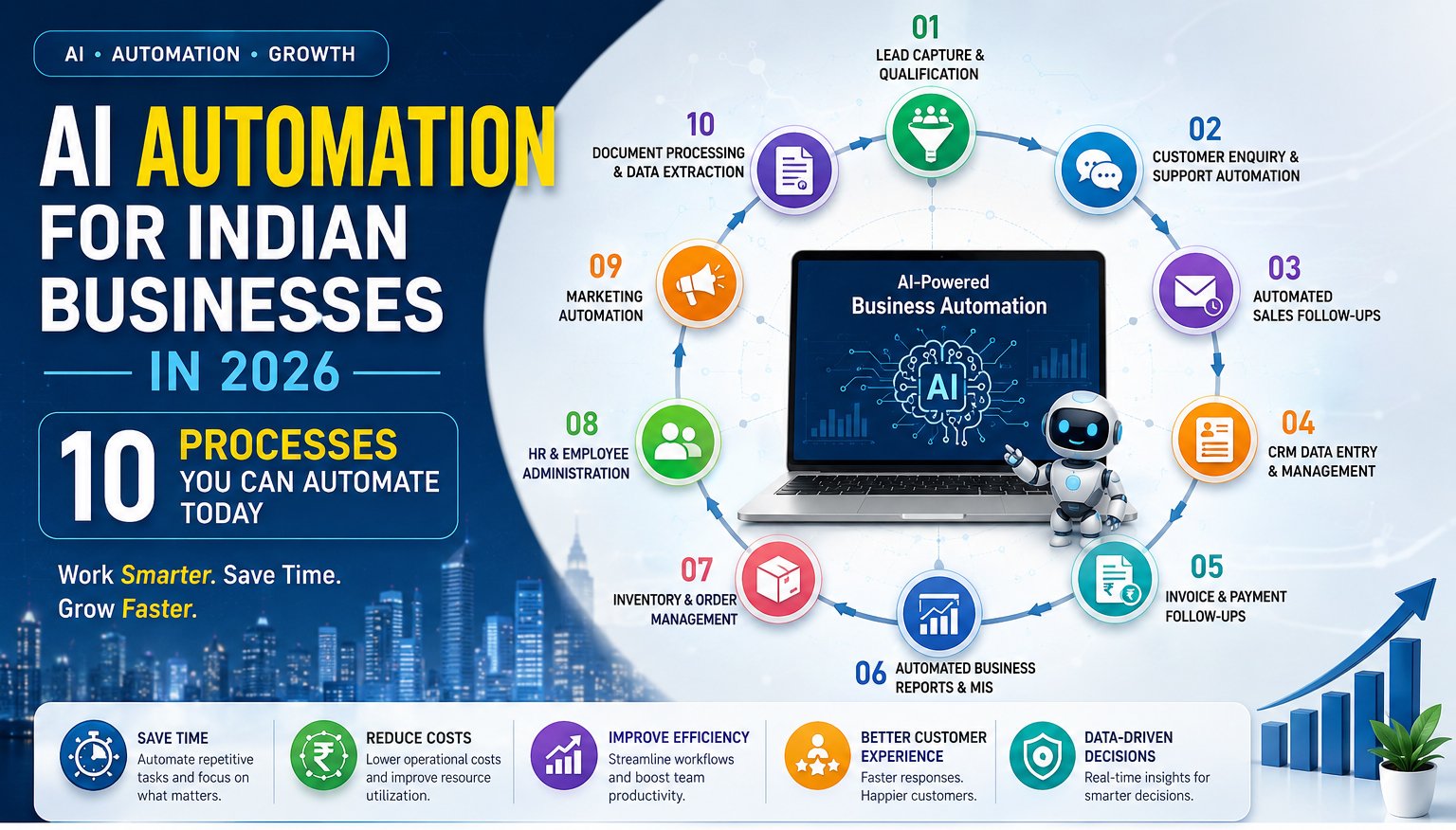
In this article, we explore 10 practical business processes that Indian companies can automate with AI in 2026.
What Is AI Automation?
AI automation combines artificial intelligence with software workflows to perform tasks that would otherwise require repeated human intervention.
Traditional automation generally follows predefined rules.
For example:
If a customer submits a form → send an email.
AI-powered automation can go further.
It can interpret information, classify enquiries, identify patterns, generate responses, recommend actions and, when properly configured, trigger the next step in a workflow.
For example:
Customer submits an enquiry → AI understands the requirement → identifies the type of customer → scores the lead → updates the CRM → sends a personalised response → alerts the sales team → schedules a follow-up.
This distinction is important.
AI automation is not simply about using ChatGPT or an AI chatbot. It is about integrating AI into the actual workflow of a business.
Why AI Automation Matters for Indian Businesses in 2026
Many businesses spend a considerable amount of employee time on activities that do not directly generate revenue.
These may include:
-
Copying data between systems
-
Responding to repetitive enquiries
-
Following up with leads
-
Preparing reports
-
Updating CRM records
-
Sending payment reminders
-
Sorting emails
-
Creating routine documents
-
Checking order status
-
Preparing internal summaries
Individually, these tasks may seem small.
Collectively, they can consume hundreds of employee hours every month.
AI automation gives businesses an opportunity to redesign these workflows so employees can spend more time on sales, customer relationships, decision-making and other higher-value activities.
The latest SMB discussion around AI is increasingly shifting from experimentation toward practical workflow integration and measurable business outcomes.
10 Business Processes You Can Automate With AI
1. Lead Capture and Lead Qualification
Lead management is one of the strongest starting points for AI automation.
Businesses receive enquiries through:
-
Website forms
-
WhatsApp
-
Email
-
Landing pages
-
Phone enquiries
-
Online advertisements
Without a structured system, sales teams may manually collect this information and enter it into spreadsheets or CRM software.
An AI-powered workflow can automatically:
-
Capture the enquiry
-
Understand the customer's requirement
-
Extract important information
-
Categorise the lead
-
Assign a lead score
-
Add the lead to the CRM
-
Notify the appropriate salesperson
-
Trigger a personalised follow-up
For example, a manufacturing company could receive an enquiry containing product requirements, quantity and delivery location.
Instead of simply storing the enquiry, AI can identify these details and route the lead to the appropriate sales team.
Business benefit
Faster response + better lead organisation + fewer missed enquiries.
2. Customer Enquiry and Support Automation
Customer support teams often answer the same questions repeatedly.
Examples include:
-
Product availability
-
Pricing information
-
Delivery status
-
Service details
-
Appointment information
-
Working hours
-
Order status
-
Frequently asked questions
AI can handle first-level customer interactions through websites, WhatsApp or other communication channels.
Instead of replacing the support team completely, AI can act as the first layer.
For example:
Customer → AI assistant → Frequently asked question → Automated response
If the question requires human intervention:
Customer → AI assistant → Complex issue → Human support executive
This human-in-the-loop approach is particularly important when dealing with sensitive, financial, legal or business-critical decisions. Recent enterprise AI discussions similarly emphasize human governance for higher-risk decisions.
3. Automated Sales Follow-Ups
One of the most common problems in sales is not generating leads — it is following up consistently.
A salesperson may speak with dozens of prospects every week.
Some prospects need:
-
Same-day follow-up
-
Next-day follow-up
-
Proposal reminders
-
Price negotiation
-
Product information
-
Meeting reminders
-
Re-engagement after several weeks
An AI-enabled CRM can monitor the sales pipeline and trigger appropriate actions.
For example:
New enquiry → Initial response → Follow-up after 2 days → Proposal reminder → Salesperson notification → Re-engagement campaign
AI can also help generate personalised follow-up messages based on the previous conversation.
This can be particularly valuable for businesses with large numbers of leads.
4. CRM Data Entry and Management
CRM systems are only useful when their data is accurate.
Unfortunately, sales teams often avoid updating CRM records because manual data entry takes time.
AI automation can reduce this problem.
For example, information from emails, forms, WhatsApp conversations or sales notes can be processed and transferred into the appropriate CRM fields.
The system could automatically identify:
-
Customer name
-
Company
-
Phone number
-
Email
-
Product requirement
-
Lead source
-
Expected purchase
-
Location
-
Sales stage
-
Next follow-up date
This transforms the CRM from a simple database into a more intelligent operational system.
5. Invoice and Payment Follow-Ups
Delayed payments can create significant cash-flow problems.
Finance teams frequently spend time checking outstanding invoices and manually contacting customers.
Automation can simplify this workflow.
For example:
Invoice generated → Payment due date recorded → Reminder before due date → Reminder on due date → Escalation after delay → Finance team notification
AI can also help classify customer communication and determine whether a payment issue requires human attention.
For businesses managing hundreds of invoices, even small improvements in this process can make a meaningful operational difference.
6. Automated Business Reports and MIS
Management Information System (MIS) reports often require employees to collect data from multiple sources and prepare spreadsheets manually.
This can involve:
-
Sales data
-
Customer data
-
Inventory
-
Accounts
-
Employee information
-
Orders
-
Marketing campaigns
An automated reporting system can collect information from connected systems and generate dashboards or scheduled reports.
AI can add another layer by summarising the information.
Instead of simply displaying:
Sales this month: ₹25,40,000
an AI-assisted system could identify:
-
Which products generated the most revenue
-
Which regions performed best
-
Which salespeople have the highest conversion
-
Which customers have reduced purchases
-
Which leads remain inactive
-
Which business metrics require attention
This changes reporting from data presentation into decision support.
7. Inventory and Order Management
Inventory management is another area where automation can provide significant value.
Businesses can use automated workflows to monitor:
-
Stock levels
-
Incoming orders
-
Product demand
-
Reorder requirements
-
Warehouse movement
-
Delivery status
AI can analyse historical information and help identify unusual patterns or potential stock issues.
For example:
If Product A normally sells 500 units per month but demand has suddenly increased by 40%, the system can alert the inventory manager.
For manufacturing, distribution and retail businesses, AI-powered inventory workflows can become particularly valuable when integrated with ERP, CRM or accounting systems.
8. HR and Employee Administration
Many HR activities are repetitive and process-driven.
Examples include:
-
Employee onboarding
-
Document collection
-
Leave requests
-
Attendance notifications
-
Interview scheduling
-
Employee communication
-
Training reminders
-
Performance information collection
AI automation can help HR teams manage these workflows more efficiently.
For example:
New employee selected → HR record created → Documents requested → Joining checklist generated → Relevant departments notified → Onboarding tasks assigned
Employees still remain responsible for decisions, approvals and sensitive matters, but automation can handle the administrative workflow around them.
9. Marketing Automation
Marketing teams also perform many repetitive activities.
AI can assist with:
-
Content ideation
-
Content drafts
-
Email campaigns
-
Lead segmentation
-
Customer re-engagement
-
Social media scheduling
-
Campaign summaries
-
Customer segmentation
-
Performance analysis
For example, a CRM could identify customers who have not interacted with a company for six months.
The system could then:
-
Identify the customer segment
-
Generate an appropriate campaign
-
Send the communication
-
Record engagement
-
Notify the sales team when a customer responds
The important point is that AI should support the marketing strategy rather than replace it.
10. Document Processing and Data Extraction
Businesses receive large numbers of documents every day.
These can include:
-
Purchase orders
-
Invoices
-
Quotations
-
Application forms
-
Customer documents
-
Delivery challans
-
Contracts
-
Reports
AI-based document processing can extract relevant information from these documents and transfer it into business systems.
For example:
Uploaded invoice → AI reads invoice → Extracts vendor, amount, GST and date → Validates information → Sends for approval → Stores data
This can dramatically reduce repetitive data-entry work.
AI Automation vs Traditional Automation
It is useful to understand the difference.
Traditional automation
Traditional automation generally follows predefined rules.
For example:
If payment is overdue → send reminder.
AI automation
AI automation can interpret information and make workflow decisions within predefined boundaries.
For example:
Analyse the customer's previous communication, determine whether the payment delay is disputed or simply overdue, select an appropriate communication template and notify the finance team if escalation is required.
Traditional automation is still extremely useful.
AI does not necessarily replace traditional automation.
In many successful systems, the two work together.
AI Automation + CRM: A Powerful Combination
For many businesses, CRM is the natural foundation for AI automation.
A modern CRM can become more than a database of customers.
It can become a central business workflow platform.
Imagine this process:
Website enquiry
↓
AI reads the requirement
↓
Lead created in CRM
↓
Lead automatically categorised
↓
Lead assigned to salesperson
↓
Personalised WhatsApp/email response
↓
Follow-up scheduled
↓
Sales activity recorded
↓
Quotation generated
↓
Order processed
↓
Customer receives updates
↓
Payment reminder triggered
↓
Management dashboard updated
This is where AI automation becomes particularly powerful.
Instead of adding another isolated AI tool, businesses can connect AI to the systems they already use.
Which Indian Businesses Can Benefit From AI Automation?
AI automation is not limited to technology companies.
It can be useful across many sectors.
Manufacturing
-
Enquiry management
-
Dealer management
-
Order processing
-
Inventory monitoring
-
Production reporting
-
Payment follow-ups
Real Estate
-
Lead qualification
-
Property enquiries
-
Follow-ups
-
Site-visit scheduling
-
Customer segmentation
Healthcare
-
Appointment management
-
Patient communication
-
Billing workflows
-
Reports
-
Administrative processes
Education
-
Student enquiries
-
Admission workflows
-
Follow-ups
-
Fee reminders
-
Communication
Logistics
-
Shipment updates
-
Customer notifications
-
Order processing
-
Delivery workflows
-
Reporting
Retail and Distribution
-
Dealer management
-
Order collection
-
Stock alerts
-
Customer communication
-
Payment reminders
How to Identify What Your Business Should Automate
Do not begin by asking:
“Where can we use AI?”
Instead ask:
“Where are we losing time?”
Look for processes that have these characteristics:
High volume
The process happens frequently.
Repetitive
Employees perform the same steps repeatedly.
Rule-based
The process follows predictable logic.
Time-consuming
Employees spend significant time completing it.
Measurable
You can measure the improvement after automation.
Low to moderate risk
A mistake will not create unacceptable consequences.
A simple starting framework is:
Volume × Time × Repetition × Business Impact
The higher the combined impact, the stronger the candidate for automation.
What Should You NOT Automate First?
AI automation should be implemented carefully.
Not every business decision should be handed to AI.
Avoid starting with processes involving:
-
High financial risk
-
Legal decisions
-
Sensitive employee decisions
-
Critical customer disputes
-
Regulatory approvals
-
Irreversible transactions
Instead, start with low-risk and high-volume processes.
For example:
Good first automation: Lead capture and CRM entry.
More complex automation: Autonomous financial approval.
This phased approach allows a business to test AI safely before expanding it.
A Practical AI Automation Roadmap for Businesses
Businesses do not need to automate everything at once.
A practical roadmap can look like this.
Phase 1: Identify the Bottleneck
Document your existing workflows.
Find processes where employees repeatedly:
-
Copy information
-
Send reminders
-
Update spreadsheets
-
Prepare reports
-
Answer repetitive questions
Phase 2: Select One High-Value Process
Choose one process that is:
-
Frequent
-
Repetitive
-
Measurable
-
Relatively low risk
Phase 3: Design the Workflow
Map:
Trigger → AI processing → Business logic → Action → Human approval → Result
Phase 4: Integrate Your Existing Systems
Connect the workflow with systems such as:
-
CRM
-
Website
-
Email
-
WhatsApp
-
ERP
-
Accounting software
-
Inventory software
-
HRMS
Phase 5: Measure the Results
Track metrics such as:
-
Time saved
-
Response time
-
Conversion rate
-
Number of missed leads
-
Administrative workload
-
Error rate
-
Customer satisfaction
Phase 6: Expand
Once the first workflow works successfully, identify the next process.
This approach is generally more practical than attempting a complete AI transformation in one project.
Common AI Automation Mistakes
1. Automating a Bad Process
If your existing workflow is inefficient, automating it may simply make the inefficient process happen faster.
Fix the workflow first.
2. Using Too Many AI Tools
Businesses do not necessarily need dozens of AI applications.
A smaller, properly integrated technology stack can be more effective.
3. Ignoring Data Quality
AI systems are only as useful as the information available to them.
Poor customer, product or transaction data can reduce the quality of automation.
4. Removing Human Oversight
Automation should not mean removing people from every decision.
Human approval remains important for sensitive or high-risk activities.
5. Focusing on Technology Instead of ROI
The goal is not to say:
“Our company uses AI.”
The better question is:
“What business problem did AI solve?”
The Future of Business Automation Is Workflow-Centric
AI is evolving from a tool that simply answers questions into technology that can participate in business workflows.
The emerging direction is increasingly focused on AI agents and systems that can interpret context, use business tools, perform multiple steps and return results while operating within defined boundaries.
For businesses, this means the opportunity is much larger than installing a chatbot.
The future may involve AI systems that coordinate activities across:
CRM + ERP + WhatsApp + Email + Accounting + HRMS + Inventory + Analytics
The companies that benefit most will not necessarily be the ones using the most AI.
They will be the ones using AI to solve the right operational problems.
Final Thoughts
AI automation is becoming a practical business strategy rather than simply a technology trend.
For Indian businesses, the biggest opportunities may not be futuristic applications. They may be the everyday processes that employees currently perform manually.
Lead follow-ups.
CRM updates.
Customer enquiries.
Payment reminders.
Reports.
Inventory alerts.
Document processing.
HR administration.
Marketing workflows.
These are the areas where businesses can start.
The most effective approach is to start small, measure the result, integrate with existing systems and expand gradually.
If your business is still managing critical processes through spreadsheets, disconnected applications, manual WhatsApp communication and repetitive data entry, 2026 may be the right time to evaluate what can be automated.
The question is no longer simply “Can AI automate this?”
The better question is:
“Which business process should we automate first?”
How Code Galaxy Can Help
AI automation works best when it is designed around the actual workflow of a business.
At Code Galaxy, businesses can explore customised solutions that combine AI, CRM, web applications, business software and workflow automation.
From lead management and CRM automation to custom business applications and AI-powered workflows, the objective should be simple:
Reduce repetitive work. Improve operational visibility. Help your team focus on growth.
If your business has a process that currently depends on spreadsheets, repetitive data entry, manual follow-ups or disconnected systems, it may be a strong candidate for automation.
Talk to Code Galaxy about building a customised AI automation solution for your business.
Frequently Asked Questions
What is AI automation for businesses?
AI automation uses artificial intelligence together with software workflows to perform repetitive business tasks, interpret information, assist with decisions and trigger actions with limited manual intervention.
Is AI automation suitable for small businesses?
Yes. Small businesses can start with relatively simple workflows such as lead capture, customer enquiries, CRM updates, appointment scheduling, payment reminders and reporting.
How is AI automation different from normal automation?
Traditional automation generally follows predefined rules. AI automation can additionally interpret unstructured information, classify data, generate content and make workflow decisions within defined boundaries.
Can AI automation integrate with an existing CRM?
Yes. AI automation can be integrated with CRM systems to automate lead capture, qualification, follow-ups, customer communication, data entry and reporting.
Can AI automate WhatsApp customer enquiries?
AI-powered WhatsApp workflows can help businesses handle frequently asked questions, capture enquiries, qualify leads and route conversations to human employees when necessary.
Will AI automation replace employees?
The primary business benefit should be reducing repetitive administrative work and allowing employees to focus on higher-value activities. Human involvement remains important for complex, sensitive and high-risk decisions.
Which business processes should be automated first?
Start with processes that are repetitive, high-volume, time-consuming, measurable and relatively low risk. Lead capture, CRM data entry, customer support and follow-up workflows are common starting points.
How much does AI automation cost in India?
The cost varies significantly depending on the workflow, integrations, AI requirements, number of users, data sources and level of customisation. A simple workflow can be substantially less expensive than a fully integrated AI-powered CRM or enterprise automation platform.
How do I start AI automation for my business?
Start by documenting your existing processes, identifying the biggest operational bottleneck and selecting one high-value workflow to automate. Measure the results before expanding to additional processes.
Does Code Galaxy develop customised AI automation solutions?
Yes. Code Galaxy can develop customised software solutions that combine AI, CRM, web applications, APIs and business workflows based on an organisation's operational requirements.